Error Feedback Loops Improve AI Accuracy
Artificial intelligence models are designed to process vast amounts of data, recognize patterns, and generate predictions or responses. However, no AI system is perfect, and errors are inevitable. The key to improving AI accuracy lies in its ability to learn from mistakes, and this is where error feedback loops play a crucial role. These loops provide AI systems with continuous feedback on their errors, allowing them to refine their predictions, enhance decision-making, and ultimately become more reliable over time.
Error feedback loops function by identifying incorrect outputs, analyzing the reasons behind them, and making adjustments to the AI model. When an AI system generates a response or prediction, it is compared against a correct answer or validated by human reviewers. If an error is detected, the system records the mistake, updates its learning parameters, and adjusts future predictions accordingly. This iterative process ensures that AI continually improves its accuracy, reducing the chances of repeating the same errors.
One of the primary ways error feedback loops enhance Al hallucination detection and accuracy improvement is through supervised learning. In this approach, AI is trained using labeled datasets where correct answers are already known. When the model makes mistakes, the errors are flagged, and corrective adjustments are made during training. Over multiple iterations, the model fine-tunes its parameters, learning to recognize patterns more effectively. This process helps AI systems develop a more precise understanding of data relationships, leading to better predictions and fewer inaccuracies.
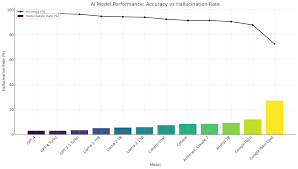
How Do Error Feedback Loops Improve AI Accuracy?
Reinforcement learning is another area where error feedback loops are highly effective. In this method, AI systems receive rewards for correct decisions and penalties for incorrect ones. By continuously adjusting their strategies based on feedback, these models gradually learn to optimize their decision-making. A well-known example is reinforcement learning in game-playing AI, where systems like AlphaGo and AlphaZero improve by analyzing past mistakes and adjusting their strategies. This form of learning allows AI to refine its accuracy dynamically, adapting to new challenges over time.
Error feedback loops also play a vital role in AI applications that involve natural language processing and speech recognition. AI models in these fields often struggle with understanding context, nuances, and ambiguous phrases. By incorporating feedback from user interactions and expert reviews, AI systems can identify areas where they misunderstood or misrepresented information. This ongoing correction process helps refine language models, improving their ability to generate coherent and contextually appropriate responses. The integration of reinforcement learning with human feedback (RLHF) further enhances AI accuracy, ensuring that models align with human expectations and factual correctness.
Another advantage of error feedback loops is their ability to detect and mitigate biases in AI models. Many AI systems inherit biases from their training data, leading to skewed or unfair outcomes. By incorporating feedback from diverse sources, AI can learn to recognize and correct biased patterns. This is particularly important in applications such as hiring algorithms, medical diagnostics, and legal decision-making, where fairness and accuracy are critical. By continuously refining their models through feedback loops, AI systems can move toward more equitable and reliable decision-making.
Despite their effectiveness, implementing error feedback loops comes with challenges. The process requires high-quality feedback data, human oversight, and computational resources to process large volumes of corrections. Additionally, balancing between learning from past errors and maintaining generalization capabilities is crucial to avoid overfitting, where AI becomes too specialized to specific training data and performs poorly on new inputs. Researchers are continuously developing techniques to optimize feedback mechanisms, ensuring that AI models learn efficiently without compromising adaptability.
Error feedback loops are fundamental to improving AI accuracy. By systematically analyzing and correcting mistakes, AI systems refine their predictions, enhance decision-making, and reduce biases. Whether through supervised learning, reinforcement learning, or user interactions, these loops enable AI to evolve continuously, adapting to new challenges and increasing reliability. As AI technology advances, the refinement of error feedback mechanisms will remain a key driver in developing more accurate and trustworthy AI systems.